So you’ve decided your website needs an AI chat solution. Great call! Your buyers are quickly embracing conversational tools, and ‘chatbot’ isn’t a dirty word anymore.
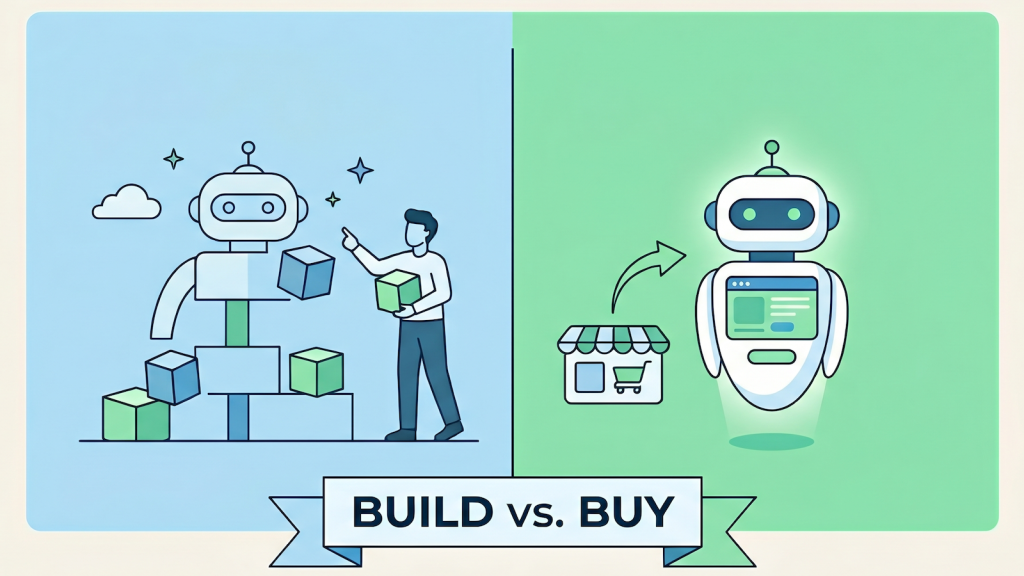
The question is whether to build one yourself or use an existing platform. It sounds like a technical decision, but it’s actually a business one: how much time, money, and internal resources are you willing to put in before you start seeing results?
Both paths can work. But they are not equally practical for most businesses. Here’s a look at both sides.
Building Your Own
For companies with strict data requirements or deeply proprietary systems, a custom build has real appeal. You own everything: the code, the data, and the full experience. There are no platform constraints on what you can build or how it behaves.
The upside:
- Complete customization
- Every aspect of the chatbot can be designed around your exact workflow, branding, and user experience. Nothing is off limits and nothing has to be a workaround.
- Full data control
- You decide where data lives, how it is stored, and who can access it. For regulated industries or organizations with strict security requirements, this can be a meaningful advantage.
- No recurring platform costs
- Once built, you are not paying per conversation or per seat. For high-volume use cases, that can add up to real savings over time.
- Deep system integration
- A custom build can connect to proprietary systems that off-the-shelf platforms may not support, in exactly the way your team needs.
The downside:
- Significant upfront investment
- Serious AI development is not cheap. You are looking at engineering hours, infrastructure costs, and likely outside expertise before you have anything usable.
- You need the right talent
- Building a capable AI chatbot requires expertise that most companies do not have sitting on the bench. Hiring or contracting for it takes time and budget.
- It takes a while
- A custom build is typically a months-long project before anything goes live. If speed matters, this path works against you.
- The work does not stop at launch
- AI models need to be monitored, maintained, and retrained as your content and offerings evolve. That is an ongoing internal commitment, not a one-time project.
Building makes sense in a narrow set of cases: you have the engineering talent, a flexible timeline, and a need that no existing solution can meet. For most businesses, that’s a pretty high bar.
Using a Platform
A proven platform lets you skip the R&D phase entirely. The hard problems of natural language understanding, reliability, and response quality have already been solved. You get a working product in days and a team behind you when you need help.
The upside:
- Fast time to value
- Most platforms can be up and running in days or weeks. You start learning from real visitor conversations almost immediately instead of waiting months for a build to wrap up.
- Battle-tested AI
- The underlying models have been trained on millions of conversations. You are not starting from zero on quality; you are inheriting years of iteration.
- It gets better on its own
- Platform providers continuously improve their products. New features, model upgrades, and performance improvements roll out without you having to do anything.
- Support is included
- When something is not working the way you expect, you have a team to call. That matters more than it sounds when you are trying to move quickly.
The downside:
- Ongoing subscription costs
- AI chat platforms can cost as little as $100/mo to $5,000/mo or more depending on scale. That is a real line item, and it does not go away.
- You work within their constraints
- Platforms offer customization, but only up to a point. If your needs are highly specific, you may run into walls.
- Vendor dependency
- Your data and workflows become tied to someone else’s platform. If they change pricing, deprecate features, or shut down, you feel it.
- Process adaptation
- Sometimes the platform shapes how you work rather than the other way around. That is a reasonable tradeoff for most teams, but worth going in with eyes open.
For most teams, this is the faster and more practical path. The tradeoffs are real, but so is the speed advantage. You can be live quickly, learn what your visitors actually need, and improve from there.
Key Questions to Consider
Whichever direction you are leaning, the decision looks different depending on your industry, your stack, and how you actually sell. These are the questions that matter most before you commit.
- Integration requirements: Does the solution connect with your CRM, marketing automation, and other critical systems?
- Seamless data flow is essential for sales follow-up and reporting.
- Industry knowledge: Can the AI understand the technical terminology and complex language specific to your field?
- Generic chatbots often struggle with niche or specialized B2B contexts.
- Customization depth: How much can you tailor conversation flows, qualifying questions, and routing logic?
- One-size-fits-all rarely works in B2B.
- Scalability and performance: Will the solution handle your current traffic and grow with you?
- Consider response times, concurrent conversations, and international support.
- Analytics and insights: What reporting is included?
- You need visibility into conversation quality, conversion rates, and common questions to improve over time.
- Total cost of ownership: What does this actually cost when you factor in everything?
- Look beyond monthly fees to implementation costs, training, and ongoing management time.
The Bottom Line
For most businesses, the build path carries more risk, more cost, and a much longer runway before you see any results. The appeal of full control is real, but so is the reality of what it takes to get there and keep it running.
A platform gets you to market faster and lets you start learning from real visitor behavior almost immediately. And in most cases, the customization and control a platform offers is more than enough to do the job well.
Ultimately though, as with most things, the best chatbot is the one you will actually use. The B2B buyer journey is changing quickly, and it’s more important than ever that your website keeps up.