Navu 4.14 introduces Catalogs, a new way to give your assistant grounded, queryable access to your structured product data. When your catalog is large and complex, Catalogs helps visitors find exactly what they need and get accurate answers instead of guesses. Here’s what’s new:
Introducing Navu Catalogs
When your company has a large, complex product catalog, customers struggle to find the right thing. They type a full question into your search box and get a long list of the wrong results. They try faceted search and get lost in filters. They know what they need. Your site just makes them work too hard to find it.
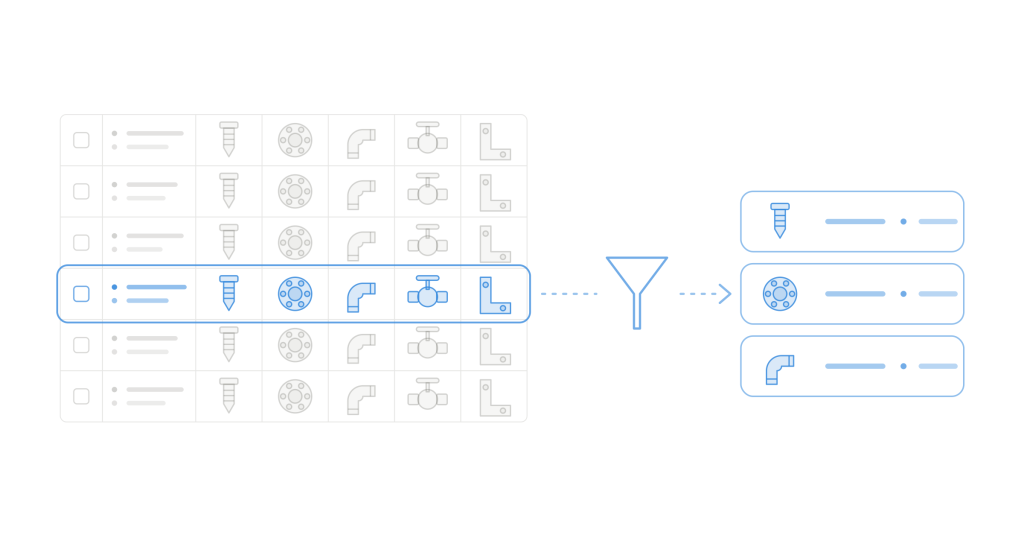
A Catalog is a structured representation of the products, locations, services, or other items your visitors are trying to find. Picture a very large spreadsheet: one row per item, one column per name-value property. Many cells are blank, because a property that matters for one item is irrelevant to another.
That structure is the whole point, and it’s exactly what most AI search throws away.
Why structured data needs more than RAG
Most AI search relies on RAG (retrieval-augmented generation) to make website content available to an assistant. RAG is great for pages, articles, FAQs, and guides. It’s less suited to structured product data.
Choosing a product means filtering, comparing, counting, matching, and ranking across many attributes at once: fit, compatibility, price, rating, inventory, ship time, dimensions, certifications, and more. RAG alone isn’t reliable for that kind of work. Models will produce a fluent, convincing answer even when the data behind it is incomplete.
Give that same intelligence the right tool, your structured catalog made directly queryable, and everything changes. When the answer depends on data, the assistant queries your catalog instead of guessing. And when your catalog doesn’t contain what was asked for, it says so.
See the difference yourself
Here’s an experiment worth five minutes.
Open ChatGPT, Gemini, or Claude, whichever you trust most. Think of a real question one of your customers might ask, the kind with five or six constraints at once. Name your company or paste your website. Then ask.
These are extraordinary models, and they’ll try hard. But one of a few things is likely: you’ll get generic buying advice instead of your products; specific-sounding product names, specs, or prices that turn out to be invented; or a confident count of items the model has no real way to know. The harder and more specific your question, the clearer the difference.
That’s not because the model isn’t smart. It’s because it’s guessing. It doesn’t have grounded, queryable access to your catalog, so it fills the gap with something plausible.
RAG and Catalogs, Working Together
Many real questions need both kinds of knowledge: the explanatory content on your site and the hard data in your catalog. Navu uses RAG to understand your content, then uses Catalogs to cross-reference structured data, applying constraints, comparing options, and returning specific, reliable answers.
A real example
Suppose you run a car-parts store. A visitor asks:
“I need front brake pads for a 2018 Toyota Camry SE that are low-dust, fit OEM wheels, cost $60 to $120, ship in 3 to 5 days, and have at least a 4.5-star rating.”
You carry 25,000 parts, each with its own page, plus dozens of articles explaining brake types, fitment, materials, warranties, and installation. RAG alone won’t reliably apply all seven constraints across the full catalog. With Navu Catalogs, the answer can be:
“Sure. We carry 17 sets of front brake pads that meet your requirements. Here are a few strong options, with price, availability, rating, and links to each product page. Is low noise also important to you?”
The number isn’t a guess
That “17” isn’t a guess. The assistant actually ran your constraints against your catalog, and 17 rows matched every one. Every option it shows links to a real product page, with price and availability drawn from your live data. If only three had matched, it would have said three. If none had, it would have told the customer and offered to relax a constraint, rather than inventing a match.
That is the experience customers expect: accurate recommendations, specific products, clear next steps, and a natural conversation that helps them decide.
Getting Started
In many cases, Navu can pull your product catalog and prepare it with little effort from your team. Prefer more control? Point us at your product feed and we’ll take it from there, and keep it in sync so prices and availability stay current.
Beyond products
We’ve focused on products, but the same technology works for any large, complex list your visitors need to search or filter: resellers, real-estate listings, doctor’s offices, service providers, parts, locations, programs, plans, and more.
If your visitors are having trouble finding the right thing, Navu Catalogs can help them get accurate answers faster, and help you turn more searches into successful outcomes.