What do buyers actually want to know when they land on your website? We got curious, so we went and looked.
We pulled every question visitors typed into the Navu Sidebar on ten customer websites between Oct 3 and Nov 2, 2026. After clearing out the spam, test messages, hellos and one-click site actions, we had 8,890 real questions to sort through.
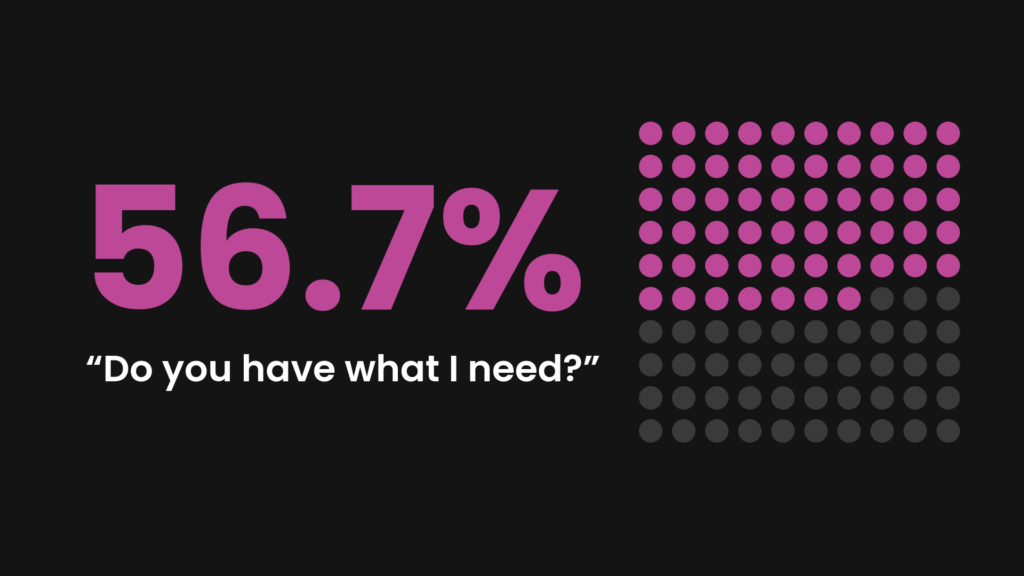
A few patterns jumped out. Most questions fell into four groups that roughly follow the path a buyer takes toward a purchase, and more than half came down to one simple thing: “Do you have what I need?”
Here’s what we found, and what we think it means for your site.
The big picture
Here’s how all 8,890 questions shook out. We put each one into a single group, so every bar shows that group’s share of the total. The four buyer questions are on top, and the questions that came from somewhere else are below
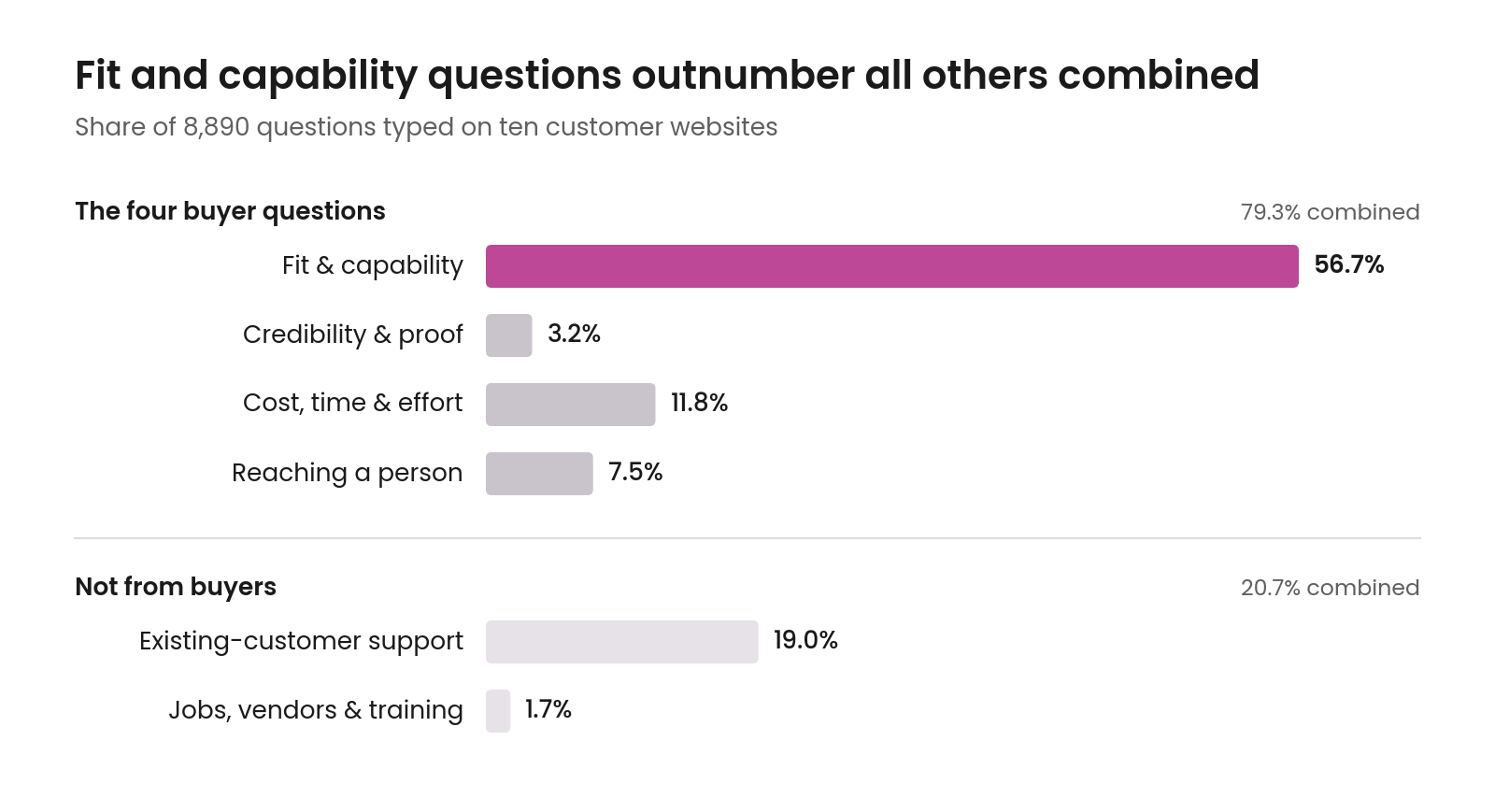
Nearly four out of five questions (79%) are one of the four buyer questions. The second-biggest group, at 19.0%, comes from existing customers rather than people evaluating you. More on that one below.
1. Can you do what I need? (56.7%)
Every buyer starts here, and it shows. Fit and capability questions make up 56.7% of everything we saw: buyers checking whether you make, stock or can build the exact thing they need.
“Can you provide a precast box culvert with a 24′ span and a 10′ rise?”
Plenty of these aren’t even full sentences. About 43% are four words or fewer, usually a product name or part number typed straight into the box. These buyers aren’t browsing; they know what they want, and they want to know fast whether you’ve got it.
This is the top of the funnel. If buyers can’t get a quick answer here, there’s a good chance the rest of the conversation never happens.
2. Can I trust you? (3.2%)
Only 3.2% of questions ask for proof, but don’t let the small number fool you. A buyer who asks this has already decided you might be able to do the job. Now they’re deciding whether to bet on you.
“I work in the automotive space. How do you help customers like me?”
When buyers ask, they want case studies, certifications and approvals, warranty details, or where your products are made. This is the question that moves them deeper into the funnel. So when someone asks it, you’d better have a good answer ready.
3. What will it cost? (11.8%)
Once buyers think you’re a fit and trust you, they want to know what it’s going to take. These questions make up 11.8% of the total, and they’re about cost in every sense: money, time and effort.
Most are about price, with about 59% asking for a price or a quote. About a third ask how to buy, like ordering, minimums, samples or signing up. Only a handful ask about lead time.
“I need to order a few items but I see no prices. Do I need to request a quote?”
You can almost hear the sigh in that one. The buyer is ready to go and can’t see the next step. When the route to a price isn’t clear, it’s awfully easy to go find a supplier whose route is.
4. Can I reach a real person? (7.5%)
At the bottom of the funnel, buyers want to talk to someone. Requests to reach a person make up 7.5% of questions: a phone number, an email address, the local rep for their area, or just a human being.
“I previously sent a quote request for an upcoming bid and have not received a response. Is there a phone number to reach someone? The bid is tomorrow.”
Some of these buyers have already tried another route and hit a wall. Maybe a form went unanswered, or the contact page didn’t say who covers their area. They don’t need a new way to reach you; they need the ways you already have to be easy to find and quick to respond.
Outside the funnel: “Can you help with what I already bought?” (19.0%)
Not every question comes from someone deciding whether to buy. Existing customers asking for help made up 19.0% of all questions, covering logins, billing, order status, returns, and setting up or fixing things they already own.
These are a different kind of question. Evaluation questions are about whether to choose you, while support questions are about getting value from a choice someone already made. How many you’ll see depends a lot on what kind of company you are: some sites saw basically no support questions, while others saw a lot.
Your website is handling both at the same time. A clear, easy-to-find route to support keeps customers happy and keeps your buying paths clear for the people still evaluating you.
What this means for your site
Buyers take the easiest route to an answer. If your site makes that route hard, the easiest route leads to someone else. Here’s where we’d focus:
- Make your whole catalog answerable. Buyers type part numbers and product names and expect a straight answer, so your product data needs to be complete, structured and easy to search.
- Answer proof questions on the spot. When someone asks whether you’ve worked with companies like theirs, the answer should come from the case studies, certifications and approvals you already have, right when they ask.
- Turn price questions into a next step. Even if you don’t publish prices, every “what will it cost?” should end with a clear path to a quote.
- Send people to the right place. Point buyers to the right rep, region or team, and point existing customers to support.
- Keep listening. The questions visitors type are some of the most honest market research you’ll get, so read them and let them shape your site.
Buyers are getting used to asking for answers instead of hunting for them, and the sooner your site can answer, the more often the easiest route will lead to you.